I don’t usually write about clocks or watches, unless they are by Cartier. Jackie Kennedy and Carolyn Bessette’s Tank watches sent me down a rabbit hole earlier this year.
The details surrounding the Victory Clock that Pierre Cartier gave President Franklin Delano Roosevelt on December 20, 1943 has long been another subject of fascination for me. I first delved deeply into the story back in 2014 when I was working with Cartier in New York on the history of the Cartier Mansion.
I got going on the Victory Clock again when recently I saw it at Sotheby’s 250 Years of American Art & Culture exhibit at the Breuer Building on Madison Avenue where it will be on display until August 17.
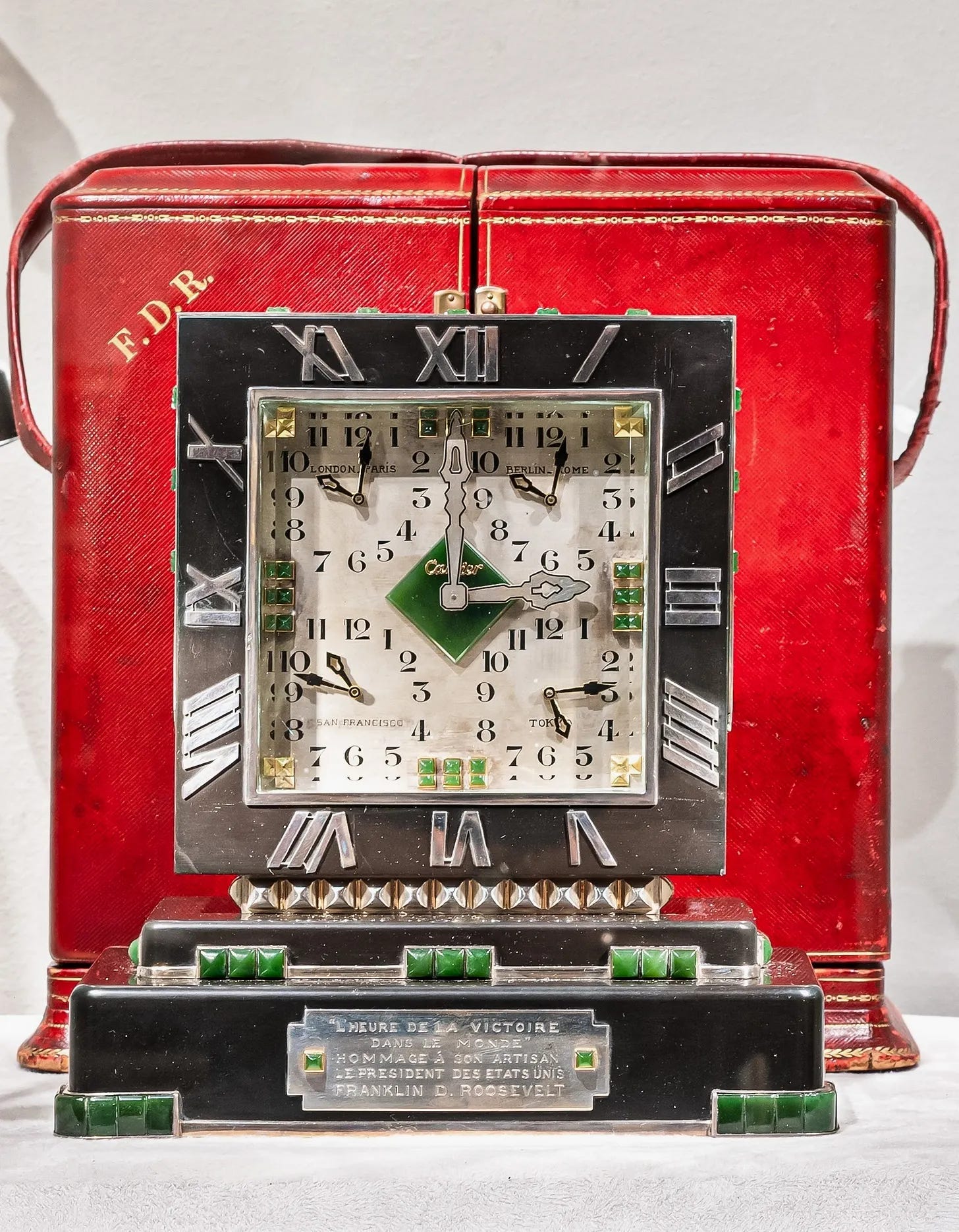
The Victory Clock had been sold at Sotheby’s in 2007 for $1.6 million to an American collector. Prior to the public sale John Roosevelt, the President’s son, sold it privately (after his parents had both died) and then that owner put it on the auction block. I believe the collector who bought it at Sotheby’s still owns the clock and loaned it for the display.
While the story in the Sotheby’s 2007 listing offers a lot of detail about the quality and physical description of the clock, it doesn’t say much about the relationship between Mr. Cartier and the President. The gracious notes exchanged by the two men when the clock was given and received can be seen here.
In the 2014 Cartier in the 20th Century catalogue for the Denver Art Museum exhibit, the authors hypothesized that Pierre Cartier “was longing for the war’s end” because “the future of Cartier’s Paris and London branches was threatened.”
This felt like oversimplification of the situation to me. The quality of the clock communicates a pre-existing relationship that was much deeper than just a sign of support to the Commander-in-Chief related to business self-interests.
I did some serious research when I was studying Cartier in 2014 and found letters from Pierre Cartier to the White House secretaries at the FDR Library. This information added to what I had learned about the French jeweler from reading old newspapers.
Pierre Cartier, who established the French House in America and orchestrated huge deals like selling the Hope Diamond to Evalyn Walsh McLean, worked on many projects outside of jewelry throughout his career.