

Remembering Ward Landrigan
He revived Verdura and Belperron and sold Richard Burton and Elizabeth Taylor three of their greatest treasures

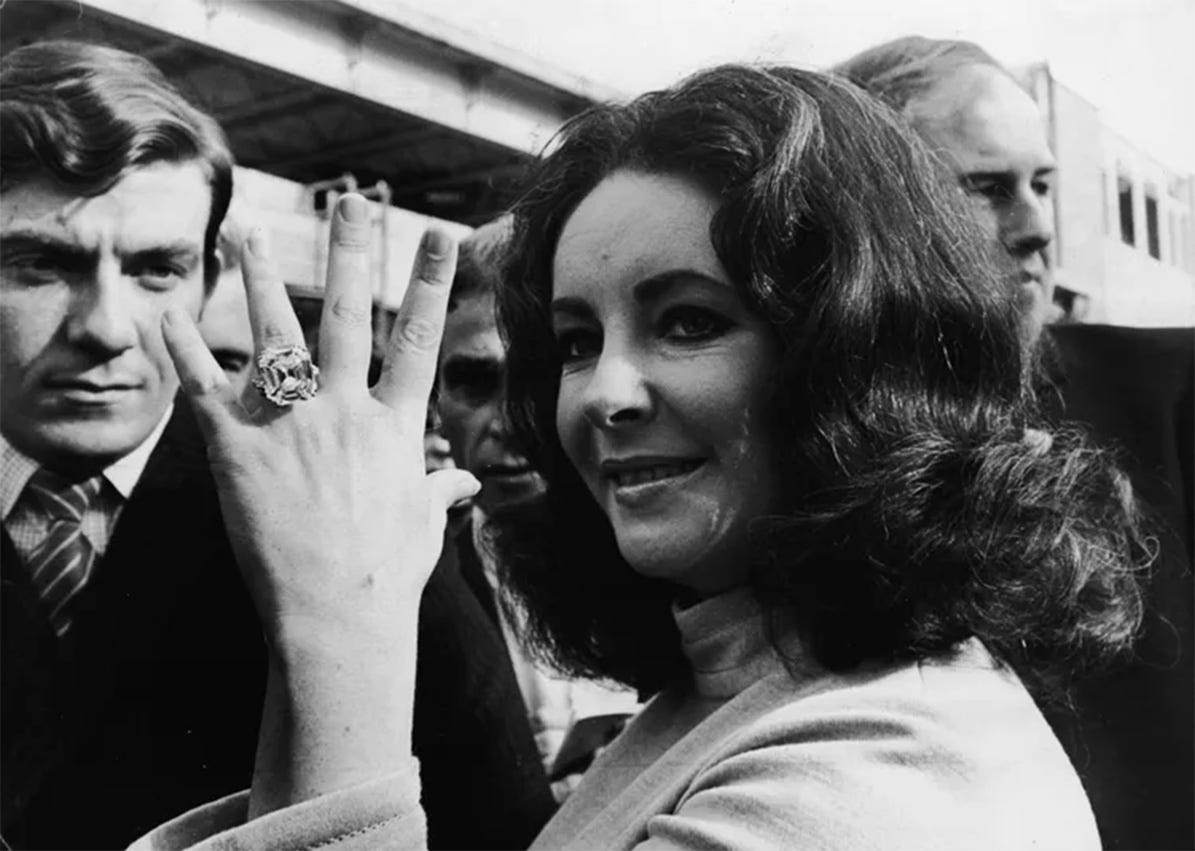
Why was Ward Landrigan standing behind Elizabeth Taylor in Bristol, England on May 20, 1968, when she was showing off her newly acquired Krupp Diamond ring to the press?
Oh how I wish Ward was here to share his story with you all. A great raconteur, Ward passed away a week ago. This picture captures one of several of his personal narratives involving jewelry sales to Richard Burton and Elizabeth Taylor.
Three days before the image was taken, Burton bought the 33.19-carat Asscher cut diamond for $307,000 from Sotheby’s Parke-Bernet auction house. And as soon as he won it, he wanted it for Elizabeth. There was just one problem. The Burtons’ insurance policy had not yet processed for the hand-off.
Ward, who had become the head of the jewelry division at Sotheby’s Parke-Bernet just three years earlier at the age of 24, was covered under the firm’s umbrella policy. So he took the diamond ring to the couple with the condition that he had to remain with the jewel at all times until their coverage kicked in.
In the picture, you can see Ward isn’t looking at the press gathered at the HTV studio in Bristol, which the Burtons invested in, nor is he looking at Elizabeth Taylor. He is looking at the diamond. He told me that the Oscar winner let every schoolgirl visiting the studio at lunchtime try the diamond on. “I nearly had a heart attack,” he remembered.
A similar situation occurred the following January when Ward sold the historic Peregrina Pearl to the Burtons for $37,000. The famous couple wanted the pearl immediately, but their insurance wasn’t ready yet. Ward flew to Las Vegas, where the Burtons’ driver picked him up from the airport in a white Rolls-Royce and took him to their massive suite at Caesars Palace.
While Ward was having a drink with Burton, Taylor dropped the pearl in another room of the suite. At first, she didn’t know where it had gone. Ward, who was responsible for it, began crawling around on the pink shag carpet when he heard what sounded like the couple’s Lhasa Apsos crack something in its teeth. Taylor wrested the historic pearl, which had belonged to the Spanish royal family and appeared in a painting by Velázquez, from the little dog’s jaws.
Later the same year, on October 23, 1969, Ward was the auctioneer at Sotheby’s Parke-Bernet who conducted the sale of the 69.42-carat diamond that would become known as the Taylor-Burton Diamond. When the gem initially sold to Cartier for just over one-million dollars it was the most expensive diamond in the world.
I vividly remember the first time I met Ward Landrigan. It was around 1991, about seven years after he had acquired Verdura. My colleague, Penny Proddow, and I had an appointment to discuss Fulco di Verdura’s stint in Los Angeles with Flato and his movie star clientele for our book Hollywood Jewels.
Ward’s office on the 12th floor of 745 Fifth Avenue was decorated with mid-century European flair. It had windows overlooking a bit of Central Park South and Bergdorf Goodman. The upstairs boutique occupies the same office space today, but the area where his desk was is now part of the showroom.
Ward made the glamorous real estate feel warm and welcoming. With a twinkle in his eye, he regaled us with stories that were generally unknown at the time. What we experienced that day was his delightful way of reawakening the brand which had become a bit sleepy, by sharing its history in the most entertaining way, as well as by creating stylish designs from Verdura’s vast archive of drawings.
Ward showed us some great Verdura jewelry that day in the most charming way. He put the long straight spike pins on the back of the brooches in his jacket lapel with as much ease and speed as I imagine Babe Paley or C. Z. Guest had when they popped on one of their Verdura brooches back in the day.
This was eons before men started wearing brooches. Ward was putting them on so we could see how the design looked against fabric. As he modeled one brooch after another and I focused on his jacket lapel, I noticed it was ever so slightly pilled. He had clearly made a habit of the presentation style which Penny told him was delightful. Without missing a beat, Ward said something about the importance of seeing jewelry on and then added, “But I stop at earrings.”
Over the years, I regularly saw Ward at Verdura parties and press previews. Then, in 2010, a year after Penny passed away, Ward and the Verdura team offered me a plum summer assignment. The job was essentially to meet with Ward once a week for a couple of hours and review the archives together to shape the narrative around stories that had never been written down. I couldn’t believe my good fortune.
In addition to the interviews we conducted we did a few field trips to talk to others. One day, we had lunch with Kenneth Jay Lane, the king of costume, in his cozy-lavish apartment situated in a Stanford White Renaissance Revival building on Lower Park Avenue. Lane knew Verdura and shared his memories over lunch, during which he smoked the entire time. It was a wonderful trip back in time.
On another occasion, we met Babs Simpson at her luxurious senior living apartment in Rye, New York. It was the same location where she was filmed for The Editor’s Eye documentary which you can see a clip of here. She had been one of the top editors at Vogue during the Diana Vreeland era and knew Verdura well. She also worked alongside Nicolas de Gunzburg, one of Verdura’s best friends. Mrs. Simpson shared stories of what it was actually like to be on some legendary photo shoots and how all the editors only wanted to wear Verdura in real life.
As a great story-teller, Ward deeply understood the value of these relationships and narratives.
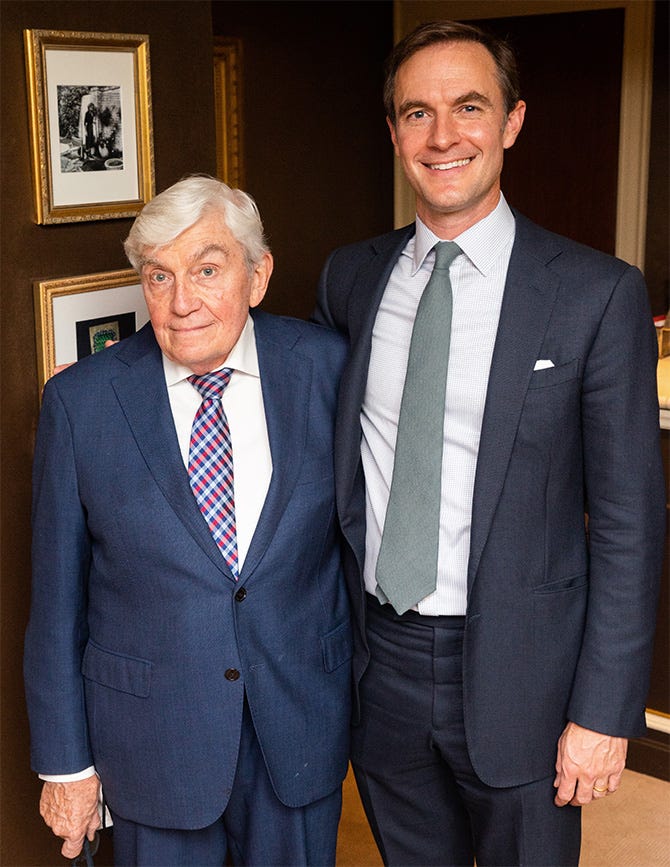
The last time I officially worked with Ward and his son, Nico, who joined the firm in 2004, was when I was curating my 2021 exhibition, Beautiful Creatures, at the American Museum of Natural History. The experience was as warm and wonderful as the first time I ever crossed the threshold at Verdura.
There was so much joy and laughter and a real sense of esprit de corps in the enormous effort it took to gather so much jewelry from private clients for the exhibition. They cast a wide net that also included vintage jewels from Belperron, which Ward acquired and began reviving in 1999.
I know I am joined by scores of people who truly admired and appreciated Ward Landrigan. Friends, clients, editors and even jewelry design students all expressed their affection and esteem for him in social media posts. The comments are filled with wonderful anecdotes about his big and small acts of kindness over a lifetime.
Ward Landrigan’s contribution to the history of jewelry is immeasurable. He will be deeply missed and always remembered.
Beautiful tribute to a wise, generous and wonderful man. Thank you Marion!
Thank you for sharing your memories of my brother. You did well capturing some of his character.